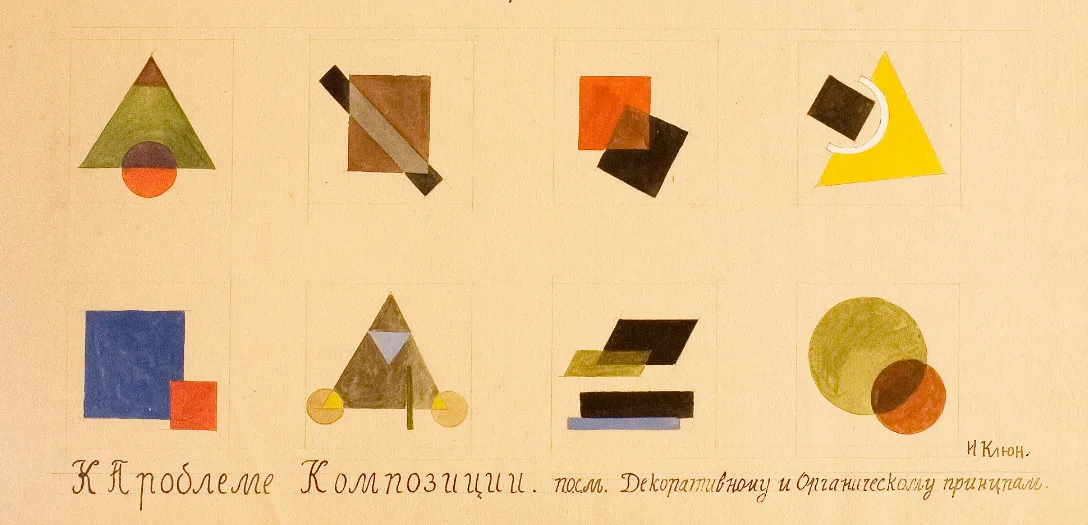
Ivan Klyun (Kliun) – Who was he?
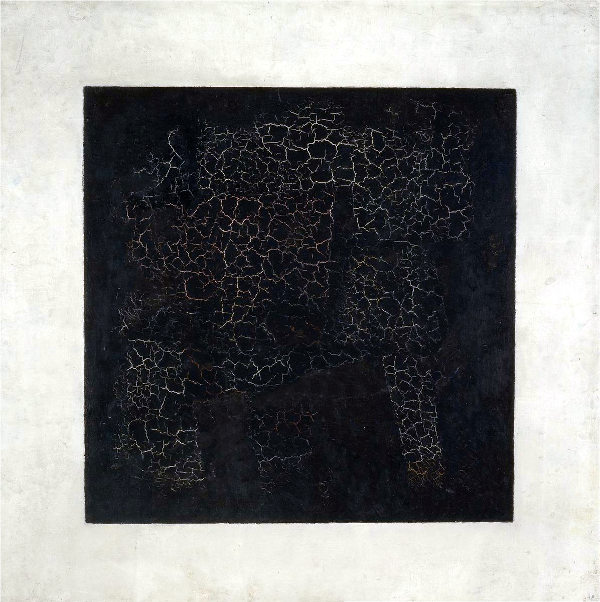
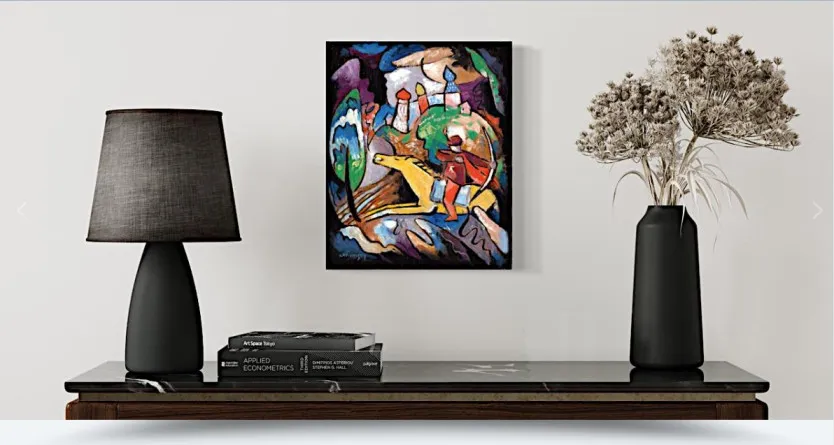
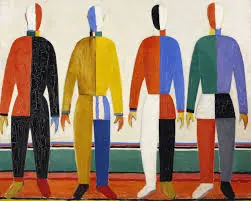
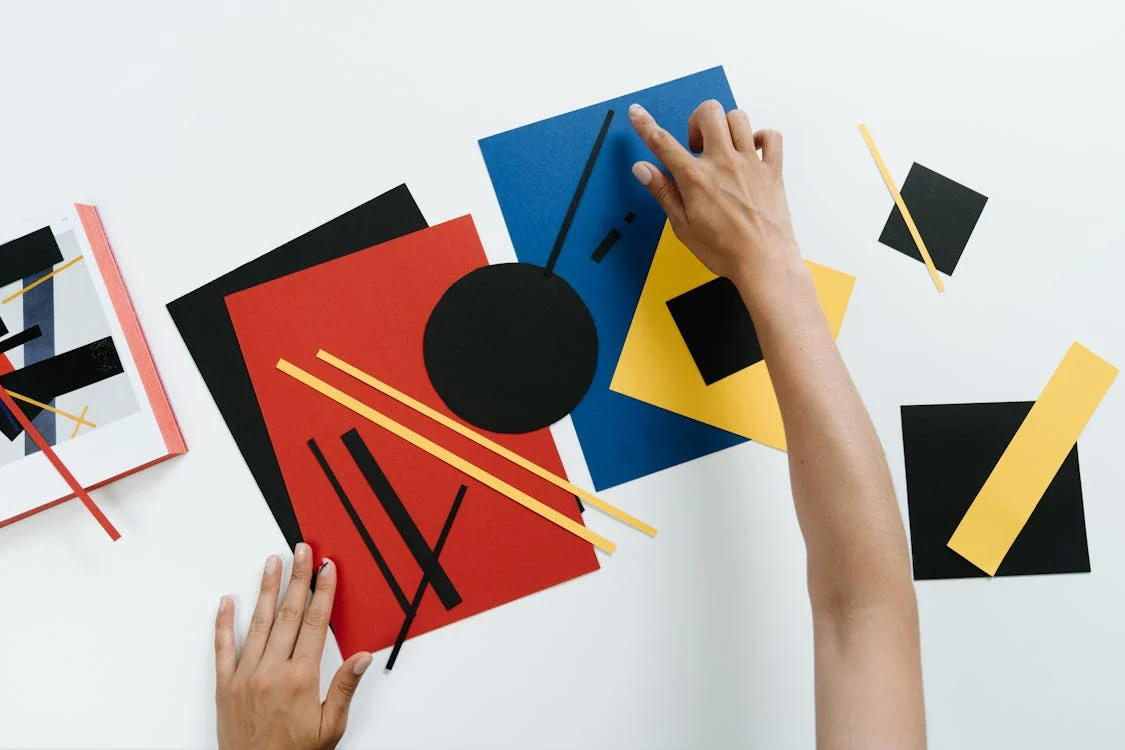
Imagine a bookkeeper with a secret passion – painting. That was Ivan Klyun (Ivan Vasilyevich Klyun – Klyunkov) , a talented Russian artist who wasn’t born with a silver spoon, but with a paintbrush in his soul. He honed his skills while balancing numbers, later studying with big names like Fyodor Rerberg. Klyun dabbled in different styles, from early influences like symbolism and Art Nouveau to the more geometric Cubism. But it was Suprematism, the movement that broke the mold with bold shapes and colors, that truly captured his imagination. He even joined forces with the movement’s founder, Kazimir Malevich, becoming a key player in the Suprematist world. Klyun’s journey…
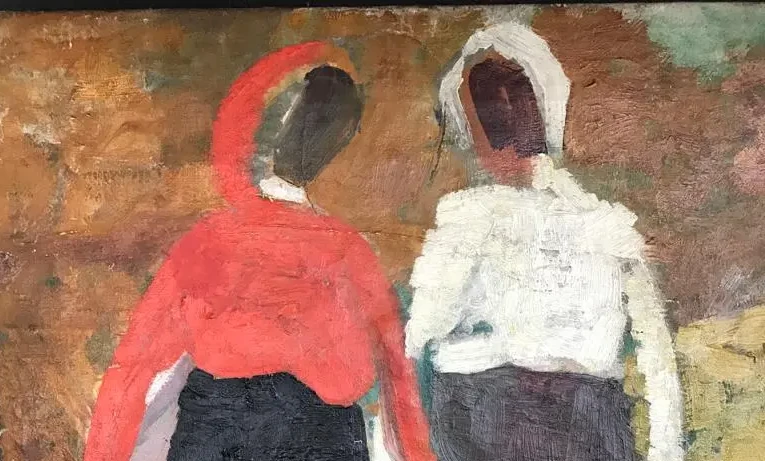
Kazimir Malevich “Two Peasants” 1929-1930
Kazimir Malevich’s “Two Peasants” is a significant piece from his later period, showcasing his exploration of form and color within his distinctive style of Suprematism. Painted in 1929-1930, it reflects Malevich’s continued interest in geometric abstraction and the reduction of forms to their essential components. In “Two Peasants,” Malevich presents two figures in a simplified, almost schematic manner. The figures are reduced to basic shapes and lines, emphasizing the geometric nature of his Suprematist style. The colors used are typically muted and limited, with emphasis on black, white, and shades of gray, enhancing the starkness of the composition. Malevich’s motivations for painting such works during this period were likely multifaceted.…
The two peasant women – Kazimir Malevich
The first owner of this painting was avant-garde artist Alexei Gan, a co-founder of the First Working Group of Constructivists with Alexander Rodchenko and Varvara Stepanova. Gan edited Kino-fot (1922–23) and co-edited Contemporary Architecture (1928), where Malevich also published articles. His partner, Esfir Shub, was a noted documentary filmmaker. Two Peasant Women belongs to Malevich’s second peasant cycle of the late 1920s. This intense painting synthesizes Malevich’s avant-garde activities, drawing from his first peasant cycle of the early 1910s. The imagery aligns with Russian icon painting, with the two women’s postures echoing saints in Orthodox Deësis. Their golden-hued background resembles traditional icon backdrops, with a two-toned pozem effect. The scarves…
Andrianov, Piotr
Piotr Nikolaevich Andrianov 1916-1995 Piotr Nikolaevich Andrianov is an outstanding example of the best type of Soviet Era painting. He was born in Moscow in 1916 to the family of a workman. He finished elementary school and went to vocational college at an engine factory where he later became an engine repairman. His family of six depended on young Piotr and his father to be the breadwinners. But Piotr was eager to draw and began attending painting courses in the evenings. Once his tutor visited Piotr’s mother and told her that her son was a gifted painter and his talent needed to be nurtured. He advised her to let him…
Maevsky, Dimitry
Dmitry Ivanovich Maevskywas born May 17, 1917 in Petrograd (Saint Petersburg; Leningrad), Russia. From 1937-1939 Mr. Maevsky studied at the Repin Institute of Arts. He enrolled in the art workshop and studio headed by the famous Isaak Brodsky. Under Brodsky’s tutelage, he learned painting in the very best naturalistic tradition of Russian Landscape, inspired particularly by Isaac Levitan and other Masters of the late nineteenth century Russian School. Mr. Brodsky’s other notable pupils included Nikolai Timkov, Alexander Laktionov, Yuri Neprintsev, Piotr Belousov, Piotr Vasiliev, Mikhail Kozell and others. Mr. Maevsky’s extensive art education also included studying in the art workshops and studios of Piotr Buchkin, regarded as one of the…
Kossenkov, Vassiliy Petrovich
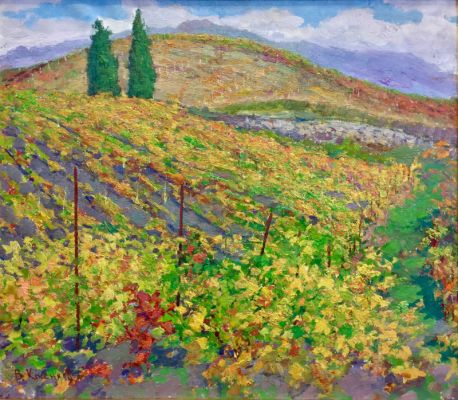
Vassiliy Petrovich Kossenkov takes his place among other renowned Soviet landscape painters such as Efrem I. Zverkov, Nikolai Efimovich Timkov, Vladimir Y. Yukin, and Vladimir Fedorovich Tokarev. These masters are brought together by openness, simplicity and delicacy. The emotional intensity of their paintings is rooted in their tender allegiance to their native land. Kossenkov was born in 1919 in the Smolenski Russian Region, or “Smolenshchina.” His father, who was a master carpenter and well-educated man, taught Kossenkov from childhood a great appreciation for art and beauty. He remained close to nature throughout his life, and traveled extensively throughout Russia, painting on location in all seasons and weather conditions. In 1937…
Semionov, Arseny Nikiforovich
ALEKSANDR MIKHAILOVICH SEMIONOVwas born February 18, 1922 in Torzhok. In 1940 Mr. Aleksandr Semionov graduated from the Tavricheskaya Street Art school in Leningrad. Since 1954 he participated in art exhibitions. Aleksandr Semionov became a member on the LCRAU in 1957. His paintings include landscapes, still life, views of Leningrad and ancient Russian towns. Personal exhibitions in Leningrad in 1987. Paintings by Aleksandr Semionov are in art museums and private collections in Russia and throughout the world. We have several pieces available, a good sampling. Explore artist stories, Russian avant-garde movements, and practical tips for navigating the fine art market—insightful reads for collectors and connoisseurs.
Tkachev, Mikhail Evdokimovich
Mikhail Evdokimovich Tkachevwas born in 1912 in a small town, Kalach, situated deep inside Russia. Ninety years ago Kalach was not even a town – just a beautiful Cossack village on the black soil not far from Voronezh. In spring the town is pink and white with blooming orchards. In summer it looks white as it is so hot at noon that you can hardly see other colors. There is a white-painted hut with blue shutters in Kalach. During the years of the revolution the house accommodated the staff of Budionny, who was one of the main heroes of the Civil War. In this house M. Tkachev spent his childhood…
Tatarinov, German Alexeevich
German Alexeevich Tatarinovwas born on September 26, 1925 in the Village of the Old Crosses, Yaroslavl Province. In 1961 Mr. Tatarinov graduated from the Moscow Printing Institute in the G. Epifanov workshop. Mr. Tatarinov received rigorous training in landscape, still life, and figurative subjects. He received public attention when he began participating in art exhibitions in 1964. He was accepted as a member of the LCRAU (Leningrad Chapter of the Russian Federation Artists Union) in 1972. Then, he was granted a personal exhibition in Leningrad in 1975. He became an Honored Artist of the Russian Federation in 2000. Today, Yaroslavl is a World Heritage Site, and one of the Golden…
Krantz, Vladimir Pavlovich
VLADIMIR PAVLOVICH KRANTZ What forms the essence of the Russian soul? What is dear to every heart? That particular warm feeling towards the wide expanse of harvest fields and the modest birch trees in early spring? The lyrical, contemplative character, which seeks for the response in a simple unpretentious view of native nature? The lyrical landscape is the genre of painting that evokes reciprocal feeling in every Russian, especially if it is done in such brilliant manner as that of Vladimir Krantz. The life itself made him an artist. He was lucky not to be forced painting in an official formal manner, glorifying the socialist labor. The artist simply polished…